
Introduction
An agent is mid-call. A neighbor is closing a deal three feet away. Someone's keyboard is clattering, a printer is jamming, and if the agent works from home, a dog just started barking at the mail carrier. The customer hears all of it.
This isn't a minor annoyance. Poor audio quality forces repeated questions, frustrates customers, and slows resolution times.
According to a Vonage analysis citing ContactBabel's US Contact Centers research, mishearing and repetition cost US contact centers an estimated $1.34 billion per year.
For a 250-seat operation, that translates to roughly $156,510 annually in wasted repetition alone.
The best noise-cancelling call center headset does two jobs at once: it makes the agent easier to hear, and it helps the agent concentrate through a full shift.
This guide compares five established business headsets across microphone noise rejection, active noise cancellation, connection type, comfort, compatibility, durability, support, and value for US call center deployments.
Key Takeaways
- Match the headset to team priorities: mic clarity, wearer-side ANC, wireless mobility, wired simplicity, or lowest cost per agent.
- Confirm desk phone, USB, softphone, and UC compatibility before you buy—not after rollout.
- Use wired USB for simple deployments; choose DECT or Bluetooth when agents need desk mobility.
- Weigh comfort, durability, warranty, and replacement cost as heavily as sticker price.
Overview of Noise-Cancelling Headsets in the US Call Center Market
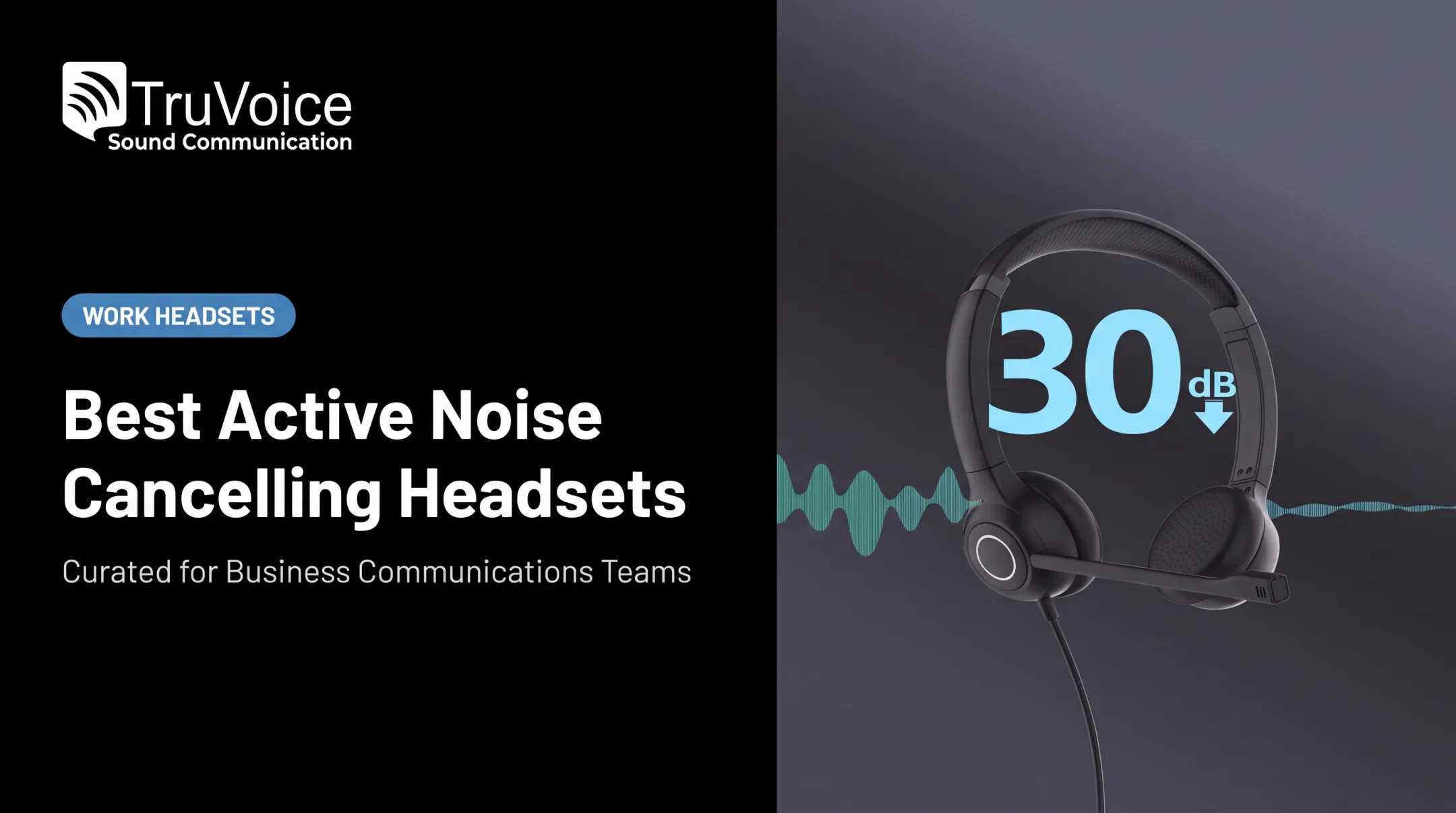
A noise-cancelling call center headset is a business headset built to improve call clarity through one or both of two separate functions. A noise-reducing microphone cleans up what the customer hears. Active noise cancellation (ANC) or passive isolation reduces what the agent hears.
This distinction gets glossed over constantly, and it shouldn't. ANC quiets the world for the agent, but it does nothing to stop the customer from hearing the conversation two desks over.
That job falls to microphone directionality, digital noise processing, and boom placement. A headset can have excellent ANC and a mediocre microphone, or the reverse.
Common US deployment scenarios include:
- High-volume inbound and outbound contact centers running hundreds of concurrent calls
- Open-plan offices where desks sit close together with minimal sound barriers
- Training rooms where supervisors monitor live calls alongside new agents
- Standardized corporate desks where IT teams need one headset model across dozens of seats
- Remote agents working from kitchens, home offices, or shared living spaces
Each environment stresses different features. A training room needs dual-headset call monitoring. A remote agent's home office needs a microphone that ignores a barking dog. That framework is how five established options stack up by use case rather than brand name alone.

Best Noise Cancelling Call Center Headsets
The following comparison looks at current specifications, microphone performance, compatibility, comfort, and support for each model. Pricing, stock, and certifications change often, so confirm current details with the manufacturer or reseller before placing a bulk order.
Jabra Engage 50 II
The Engage 50 II is a wired USB headset built for professional calling rather than general office use. Its three-microphone system handles background-noise cancellation and pairs with Jabra's Engage+ software. That software delivers live on-screen alerts for background noise, microphone positioning, silence, and interruptions during a call. This headset suits high-volume contact centers that want a consistent wired connection, predictable voice transmission, and one model standardized across every desk. Mobility is limited since it's tethered by USB, and the analytics features require a software download, which some IT teams prefer to control centrally before rollout. Specification summary:
- Connection: Wired USB-A or USB-C
- Configuration: Available in mono and stereo
- Microphone: Three-mic array with background-noise cancellation and BalancedVoice processing
- Weight: As little as 1.5 oz (45g)
- Compatibility: Certified for Microsoft Teams and Zoom (SKU-specific)
- Warranty: 3 years
- Price: Around $237–$299 depending on configuration and retailer; confirm current pricing before bulk ordering
EPOS Impact 860 or Impact 760 Series
EPOS offers two closely related models that deserve separate consideration. The Impact 860T ANC includes hybrid wearer-side ANC plus an AI-driven microphone with beamforming and a noise-canceling algorithm. The Impact 760 skips ANC but adds a three-microphone noise-suppression system and a longer standard warranty. Both are double-sided, over-ear wired headsets with padded headbands and inline controls, and both include a 360-degree busylight that signals call status to nearby coworkers. Specification summary:
| Feature | Impact 860T ANC | Impact 760 |
|---|---|---|
| ANC (wearer side) | Yes, hybrid | No |
| Microphone noise handling | AI mic with beamforming | Three-mic suppression |
| Connection | Wired USB-A/USB-C | Wired USB-A/USB-C |
| Busylight | Yes | Yes |
| Warranty | 2 years | 3 years |
| MSRP | $249.00 | $209.00 |
| Both models are Microsoft Teams and Microsoft Open Office certified, making them a reasonable fit for busy shared-office environments where a visual busy signal reduces interruptions. |
Poly Blackwire 8225
The Blackwire 8225 targets buyers who want wearer-side ANC and a noise-reducing microphone in one wired package. It offers three ANC settings (off, low, high) and a flexible boom mic with Poly's Acoustic Fence technology. Acoustic Fence filters surrounding conversations before they reach the customer. This is a strong fit for agents in shared offices who need to dial down distractions without giving up a stable USB connection. The trade-off is mobility: like the Engage 50 II, it's wired. Confirm current Teams or Zoom certification details for your specific SKU before ordering in bulk. Specification summary:
- Connection: Wired USB-C with tethered USB-A adapter
- Configuration: Stereo, on-ear
- ANC: Advanced hybrid, three settings
- Microphone: Flexible boom with Acoustic Fence noise cancellation
- Compatibility: Microsoft Teams certified, Zoom certified (version-specific)
- Warranty: 2-year limited warranty
- Price: Not listed on the current manufacturer page; check with a reseller for volume pricing
Yealink UH37
The UH37 is a value-conscious wired USB option built around Yealink's Acoustic Shield technology, using dual noise-canceling microphones. It comes in both dual-ear and mono versions, with a boom that rotates 300 degrees for either-ear wear, and a dedicated Microsoft Teams version is available. Organizations standardizing affordable headsets across many desks tend to gravitate toward the UH37. It won't match the wearer-side noise reduction of a premium ANC headset, and it doesn't offer wireless mobility, but for straightforward desk-bound calling it covers the basics without a premium price tag. Specification summary:
- Connection: USB-A and USB-C
- Microphone: Dual noise-canceling mics with Acoustic Shield
- Configuration: Dual-ear and mono versions available
- Compatibility: Teams-labeled version plus broad UC platform support
- Warranty: 24 months under Yealink's Personal Collaboration Solution category; confirm the UH37 term at purchase
- Price: Not publicly listed; request a bulk quote
Discover D722U
The D722U is an over-ear wired USB headset aimed at agents who need extended-wear comfort alongside noise reduction. Its memory-foam ear cushions with cooling gel provide passive isolation, while a uni-directional gooseneck boom microphone rotates for left- or right-ear wear. It's a practical pick for home-based agents or open-office staff who spend most of a shift on calls and need cushions that don't get hot after hour three. Controls are straightforward: mute, volume, and speaker on/off, with a five-second mute hold that disables sidetone. Specification summary:
- Connection: USB-A and USB-C
- Design: Over-ear, replaceable memory-foam cushions
- Microphone: Uni-directional, noise-canceling, flexible gooseneck
- Compatibility: Plug-and-play with Teams, Zoom, Google Meet, RingCentral, Webex
- Warranty: 3 years against physical or electronic defects
- Price: $99.99 sale, $109.99 regular

How We Chose the Best Noise Cancelling Call Center Headsets
Rankings are based on published manufacturer specifications, compatibility documentation, warranty terms, and known suitability for sustained call center use—not original lab testing.
Microphone performance, evaluated separately from ANC. A headset's ability to keep the customer from hearing typing, coworkers, or a barking dog is separate from how quiet the agent's own listening experience is.
Microsoft's testing for Teams-certified devices includes a "Premium Microphone for Open Office" designation: a mic that picks up the user's voice without transmitting neighboring sound, per Microsoft's Teams device documentation. That's the bar to check before assuming any "noise cancelling" label covers the transmit side.
Connectivity and platform compatibility. Before any bulk order, confirm the headset works with your specific desk phones, softphones, and UC platform.
| Connection type | Typical range | Typical talk time | Best for |
|---|---|---|---|
| Wired USB | Cable length only | N/A, powered by device | Fixed desks, simplest deployment |
| Bluetooth | Up to about 98 ft (~30 m) | 8–13 hours | Light mobility, smaller offices |
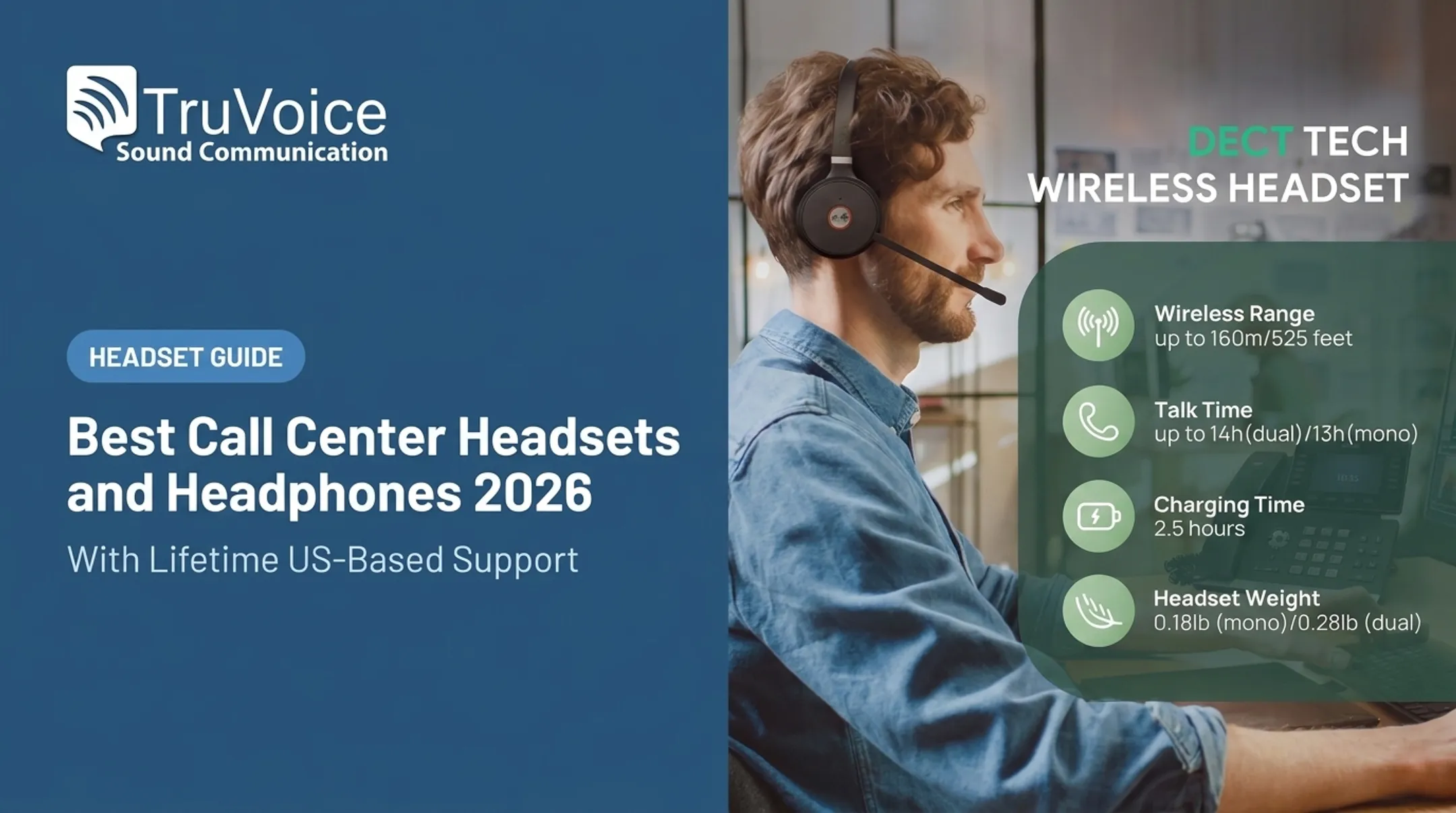
| DECT | Up to 590 ft line-of-sight (model-dependent) | Varies by model | Larger floors, higher density |
Logitech's wired-versus-wireless comparison notes that wired connections avoid environmental interference entirely, while wireless performance depends on signal strength and surroundings. Neither is universally "better." It depends on how far agents roam from their desks.

Comfort and workforce fit. Mono headsets suit agents who still need to hear coworkers or a supervisor; stereo fits noisier floors. Weight, cushion material, and glasses compatibility decide whether a headset lasts a full 8-hour shift.
Deployment economics. Purchase price is only part of the total cost. Factor in:
- Bulk discount tiers
- Replacement ear cushions and boom mics
- Warranty length and repair process
- Technical support response time
- Return policy for units that don't work out
Common buying mistakes to avoid:
- Choosing consumer ANC headphones with no dedicated business microphone
- Skipping a desk-phone or softphone compatibility check
- Picking a wireless model without confirming range and battery life against actual floor size
- Standardizing on one headset without testing it in the real, noisy environment agents work in every day
Conclusion
The best noise-cancelling call center headset consistently delivers clear outgoing speech, comfortable incoming audio, reliable connectivity, and a total cost of ownership your organization can sustain across dozens or hundreds of seats.
Before placing a large order, pilot two or three shortlisted models with actual agents in representative noise conditions. Evaluate:
- Voice clarity from the customer's side
- Comfort over a full shift
- Compatibility with your existing phone system
- How quickly support responds when something goes wrong
TruVoice Telecom works with call centers, offices, training teams, and remote workers across the US on these tradeoffs. Support includes:
- Impartial guidance on compatibility
- Bulk purchasing rates
- US-based technical support
- Lifetime product support on its range
- A 30-day money-back guarantee on website orders
That backup matters when you standardize headsets across a growing floor.
Frequently Asked Questions
What is the best noise-canceling headset for call centers?
It depends on your priorities: microphone clarity, wearer-side ANC, wireless mobility, or budget. The Jabra Engage 50 II stands out for dedicated contact-center use, but confirm current specs and pricing before buying in bulk.
What is the best noise-canceling headset with a microphone for call centers?
A strong boom microphone with background-noise rejection typically matters more for call centers than consumer-grade ANC alone. The Engage 50 II and Poly Blackwire 8225 both pair dedicated noise-canceling microphones with call-center-grade construction.
What is the best wireless headset for call centers?
DECT wireless generally offers longer range and better security for larger floors, while Bluetooth suits smaller offices needing lighter mobility. Always confirm desk-phone or softphone compatibility before choosing either.
What is the difference between active noise cancellation and a noise-canceling microphone?
ANC reduces the sound reaching the agent's ears. A noise-canceling microphone reduces the background noise the customer hears on the other end. A headset can have one, both, or neither.
Are wired or wireless headsets better for call centers?
Wired USB headsets offer simpler, interference-free deployment and no charging requirements. Wireless models add mobility but require attention to range, battery life, and pairing across a full floor.
What should a call center check before buying headsets in bulk?
Before a large order, verify:
- Phone-system and UC platform compatibility
- Microphone performance under real floor noise
- Comfort, warranty length, support quality, and bulk pricing