
Introduction
Agents spend eight hours a day with a headset clamped to their ear. If that headset is uncomfortable, drops calls, or lets background noise bleed through, it shows up in call quality, average handle time, and turnover.
Many call centers struggle to pick between wired reliability and wireless freedom without a clear framework. The right answer depends on your phone system, your floor layout, and how your agents actually work.
A fixed agent taking inbound calls all day has different needs than a supervisor walking the floor or a remote worker sharing a kitchen table. This guide compares five wired and wireless headset categories, plus one budget-friendly USB option, so you can match compatibility, microphone performance, comfort, and support to your specific setup.
Key Takeaways
- Wired headsets fit fixed agent stations; wireless fits supervisors and mobile workers
- Microphone noise handling, comfort, and durability matter more than brand name alone
- Confirm your connection type first: USB, QD, DECT, Bluetooth, or desk-phone specific
- Bulk buyers should weigh warranty, returns, and total cost of ownership, not just unit price
- TruVoice Telecom helps with value-focused sourcing and bulk buys—verify current specs before you order
Overview of Wired and Wireless Call Center Headsets in the US Market
A call center headset is a business communication device built to deliver clear two-way audio through a desk phone, computer, softphone, or unified communications platform. US buyers generally choose from four categories:
- Wired USB and QD headsets — connect directly to a computer or, via Quick Disconnect cable, to a desk phone
- DECT wireless headsets — pair with a desk-phone base station for hands-free roaming
- Bluetooth headsets — connect to computers and mobile devices, often supporting multipoint pairing
- Hybrid/multi-source models — serve more than one connection type from a single base or dongle
Wired vs. Wireless: Where Each One Fits
Wired headsets fit fixed workstations, shared desks, and bulk deployments where cost per seat matters:
- Predictable connection with no battery cycles
- Lower cost per unit at floor scale
- Simple spares and cable-based swap-outs
Wireless headsets fit supervisors, dispatchers, and hybrid teams who need to move while on calls:
- Hands-free roaming away from the desk
- Requires battery management and charging discipline
- Needs range planning around walls and RF interference
Two Different Kinds of "Noise Cancellation"
Once you pick wired or wireless, noise handling is the next spec that changes call quality. These terms get used interchangeably, but they solve different problems:
- Microphone noise cancellation reduces the background sound the caller hears from the agent's environment
- Active noise cancellation (ANC) reduces the sound the agent hears, improving their own listening experience

Test the models below against your floor noise, connection type, and budget. The right headset is the one that fits that mix—not a single universal pick.
Top Wired and Wireless Call Center Headsets
Each headset on this list was evaluated for:
- Call clarity and microphone noise handling
- Comfort across extended shifts
- Compatibility with common phone and UC systems
- Durability, controls, support terms, and bulk-buy value
TruVoice Telecom Headset Range
TruVoice Telecom is a US-based telecom equipment manufacturer and reseller that specializes in headsets, backed by more than 30 years of telecom experience. The company's range spans wired QD and USB models alongside DECT wireless options for call centers, offices, and remote agents.
Two models stand out for contact-center use:
- Agent AW70: DECT wireless, up to 500 feet of range, and 3-in-1 connectivity for desk phone, computer, and cell phone. Works with Polycom, Cisco, Avaya, Mitel, Yealink, and common UC platforms.
- HD-100: Wired QD headset with a 270-degree rotating mic boom and lifetime warranty for phones with a 2.5mm headset port.
| Feature | Agent AW70 (Wireless) | HD-100 (Wired) |
|---|---|---|
| Connection | DECT, up to 500 ft | QD cable |
| Compatible systems | Desk phone, PC, cell phone | Phones with 2.5mm headset port |
| Warranty | Manufacturer-backed | Lifetime |
| Best for | Supervisors, mobile agents | High-volume fixed stations |
TruVoice fits high-volume contact centers, corporate offices, and training teams that want bulk pricing plus 30-day no-questions-asked returns and lifetime product support on every order.
Jabra Engage 50 II Wired Headset
The Jabra Engage 50 II is a wired USB headset for contact centers, available in mono and stereo versions with USB-A or USB-C connections.
Its main strength is a three-microphone beamforming system that isolates the agent's voice from background noise before it reaches the caller. At 1.5 ounces, it stays comfortable through full shifts.
Jabra lists compatibility with Cisco, Unify, Microsoft Teams, Zoom, Google Meet, and Amazon Chime. Confirm the exact SKU before ordering. Teams-optimized versions differ from general UC configurations.
Limitations to check before ordering:
- Requires a cable connection, so mobility is limited to desk radius
- Some features depend on Jabra's Engage+ software
- Platform-specific SKUs mean the wrong version won't get full certification benefits
| Feature | Details |
|---|---|
| Connection | USB-A / USB-C, wired |
| Platforms | Cisco, Teams, Zoom, Google Meet, Amazon Chime (SKU-dependent) |
| Microphone | 3-mic beamforming, background noise cancellation |
| Warranty | 3 years |
| Best for | Busy contact centers standardizing on wired desk stations |
Jabra listed launch pricing at $279 (mono) and $299 (stereo) in 2022; current street pricing differs. Confirm stock and price before any bulk order.
Yealink WH62 DECT Wireless Headset
The Yealink WH62 is a dual/mono DECT wireless headset for office roaming. It pairs with a dedicated base station rather than relying on consumer Bluetooth.
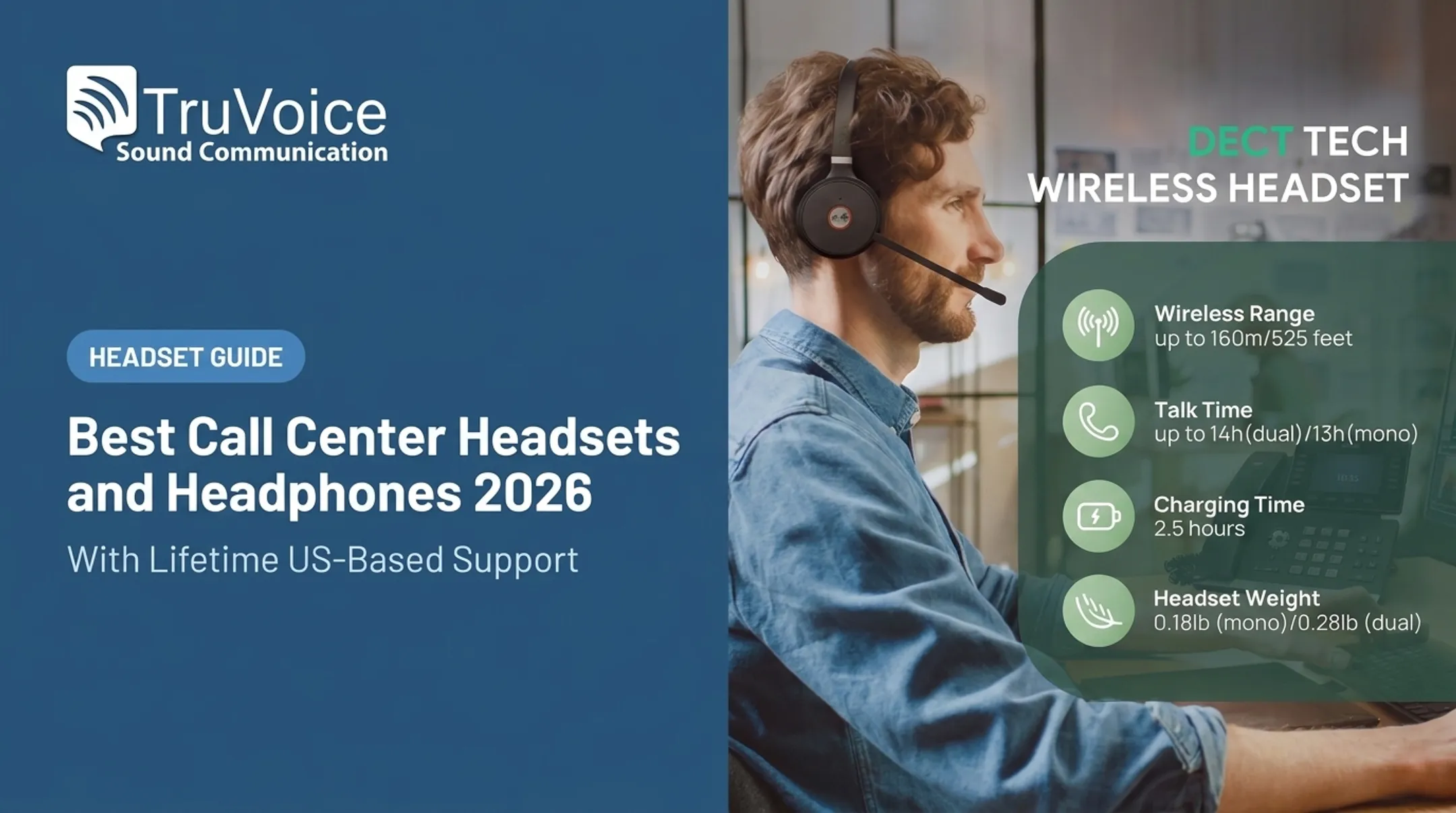
Yealink states the WH62 delivers up to 160 meters (525 feet) of range from base to headset, though walls and physical obstructions will reduce that in practice. Talk time runs up to 13 hours mono or 14 hours dual, and dual microphones filter background noise for clearer calls.
Key operational details:
- Supports simultaneous PC and desk-phone connection through one base
- Charging stand included; full charge takes about 2.5 hours
- No US-specific warranty period was listed on the manufacturer page, so confirm this directly with your supplier
| Feature | Details |
|---|---|
| Connection | DECT wireless, base station required |
| Range | Up to 525 ft (line-of-sight, obstruction-dependent) |
| Talk time | Up to 13-14 hours |
| Simultaneous devices | PC + desk phone |
| Price example | $194.99 (CDW, dual UC with stand) |
| Best for | Agents needing hands-free movement around a desk phone |
Poly Blackwire 8225 Wired UC Headset
The Poly Blackwire 8225 is a wired stereo headset connecting via USB-A or USB-C. It suits offices and contact centers that want stronger noise management on both ends of the call.
It separates two features that often get confused. Acoustic Fence uses two microphones to cut background noise the caller hears. Hybrid ANC uses four digital microphones with off/mid/high settings to reduce what the agent hears.
The headset is Microsoft Teams Certified and meets Microsoft's Open Office requirements, with PC audio optimized for wideband voice up to 7 kHz.
At 186 grams with fully adjustable, pivoting speakers, it is designed for long shifts. Independent long-term comfort data beyond manufacturer claims was not available at the time of research.
| Feature | Details |
|---|---|
| Connection | USB-A / USB-C, wired |
| Certification | Microsoft Teams Certified, Open Office |
| Microphone (caller side) | Acoustic Fence, 2-mic |
| ANC (agent side) | Hybrid ANC, 4-mic, 3 settings |
| Price | $156.87 sale / $192.95 regular (TruVoice) |
| Best for | Offices needing wired UC connectivity with strong dual-sided noise control |
EPOS Impact 700 Series Wired Headset
The EPOS Impact 730, part of the Impact 700 line, is a single-ear wired headset connecting via USB-C (USB-C-to-USB-A adapter included). It fits professional setups where agents need one ear open to their surroundings.
It connects to Microsoft Teams, RingCentral, Zoom, and other leading UC applications, with an ergonomic inline controller for call handling. EPOS markets its Open Office headset line around noise attenuation, claiming that reduced background noise can improve reaction time efficiency by up to 40% without sacrificing precision. Treat that as a manufacturer-published claim and validate it against your own floor noise levels.
| Feature | Details |
|---|---|
| Connection | USB-C, wired |
| Style | Single-ear (mono) |
| Platforms | Teams, RingCentral, Zoom, other UC apps |
| Warranty | 3-year extended (TruVoice-listed) |
| Price | $136.00 sale / $209.00 regular |
| Best for | Teams wanting all-day comfort with situational awareness |
Affordable USB Headset: TruVoice VoicePro 10 UC
Not every deployment needs a premium contact-center headset. The TruVoice VoicePro 10 UC is a lower-cost wired option suited to remote agents, small offices, onboarding teams, and organizations replacing a limited number of units without a full-floor budget.
Trade-offs versus premium models:
- Simpler noise handling than beamforming or ANC-equipped headsets
- Fewer software integrations and inline controls
- Shorter feature list, but a much lower entry cost
- Still backed by TruVoice's standard support and returns policy
| Feature | Details |
|---|---|
| Connection | USB, wired |
| Compatibility | Softphone and UC platforms |
| Price | $35.96 sale / $44.95 regular |
| Warranty/support | TruVoice standard policy, lifetime support |
| Best for | Budget-conscious remote and small-office deployments |

How We Chose the Best Call Center Headsets
Our evaluation combined manufacturer specifications, available independent documentation, compatibility requirements, and real operational needs rather than relying on brand popularity.
Microphone and Audio Performance
We looked for credible documentation on how each headset handles speech clarity, typing sounds, and open-office chatter. We also kept a clear line between two distinct features:
- Microphone noise cancellation — protects call clarity for the person on the other end
- ANC or passive isolation — protects the agent's own listening experience
Manufacturer-published test claims, like EPOS's noise-attenuation figures, are useful directional evidence but not a substitute for testing in your own environment.
Comfort and Durability
Extended shifts punish poorly designed headsets. We assessed weight, cushion material, mono versus stereo wearing styles, and boom or cable durability.
Jabra's Engage 50 II, for example, underwent stress testing for boom-arm rotation and impact resistance, backed by a 3-year warranty. Warranty length and replacement-part availability matter as much as launch-day specs.
Compatibility and Deployment
Before standardizing across a whole floor, verify the headset works with:
- Your desk phones (many models list compatibility with brands like Polycom, Cisco, Avaya, Mitel, and Yealink)
- Softphones and UC platforms such as Microsoft Teams, Zoom, or RingCentral
- USB ports, QD adapters, DECT bases, or Bluetooth as required
Test a small batch first. A headset that works perfectly with one softphone version may behave differently on another, and platform certifications are often SKU-specific.

Wired vs. Wireless Operating Fit
| Factor | Wired | Wireless |
|---|---|---|
| Upfront cost | Lower | Higher |
| Mobility | Desk-bound | Full roaming within range |
| Charging | None | Required, battery management |
| Interference risk | None | Possible with DECT density |
| Best for | Fixed agents, shared desks | Supervisors, dispatchers, hybrid teams |
The US uses the 1920-1930 MHz band for DECT devices under FCC rules. Confirm any wireless SKU is FCC-compliant for US deployment, and pilot DECT density before a full rollout if you're running many wireless headsets in close proximity.
Procurement Value and Support
Bulk buyers should weigh support, returns, and lifetime coverage alongside sticker price. TruVoice Telecom, for instance, includes:
- 30-day no-questions-asked returns
- Lifetime product support
- Bulk-order rate discounts
- $14.95 flat-rate shipping across the contiguous US, free on large bulk orders
Always verify current terms directly before a large purchase, since policies and pricing shift over time.
Conclusion
The right call center headset matches your phone system, noise environment, agent workflow, and budget.
Choose based on how your team works:
- Wired headsets fit fixed agent stations and cost-controlled bulk deployments
- Wireless models justify the higher cost when supervisors, dispatchers, or hybrid teams need mobility without dropping calls
Before a floor-wide rollout, test a small batch of your top candidates on your actual phone system and noise conditions. For a call center, corporate office, or remote team, TruVoice Telecom offers impartial headset guidance, US-based technical support, and bulk-purchase help to narrow the field.
Frequently Asked Questions
What are the best affordable headsets for phone calls?
Look for a wired USB model with clear microphone audio, verified compatibility with your softphone, comfortable ear cushions, and a solid warranty. Check current pricing and availability before ordering, since budget models change stock frequently.
What is the best headset for call center agents?
It depends on the agent's phone system, floor noise level, and whether their station is fixed or mobile. Fixed agents generally do best with wired USB or QD headsets, while mobile or hybrid agents benefit more from DECT wireless models.
What is the best wireless headset for a call center?
DECT wireless headsets suit desk-phone environments with dedicated bases and longer range, while Bluetooth suits multi-device flexibility for computers and phones. Compare range, battery life, microphone noise reduction, and charging setup before choosing.
What is the best wired headset for a call center?
USB models suit computer-based softphones, while QD models suit traditional desk phones. Prioritize microphone performance, comfort for full shifts, durable boom and cable construction, and confirmed compatibility with your existing platform.
What is the best headset for work calls?
Remote and office workers should compare USB, Bluetooth, or hybrid connectivity based on their devices. Then check microphone clarity, all-day comfort, platform support (Teams, Zoom), and background-noise filtering.